Happy 697th to the Ming Founder!

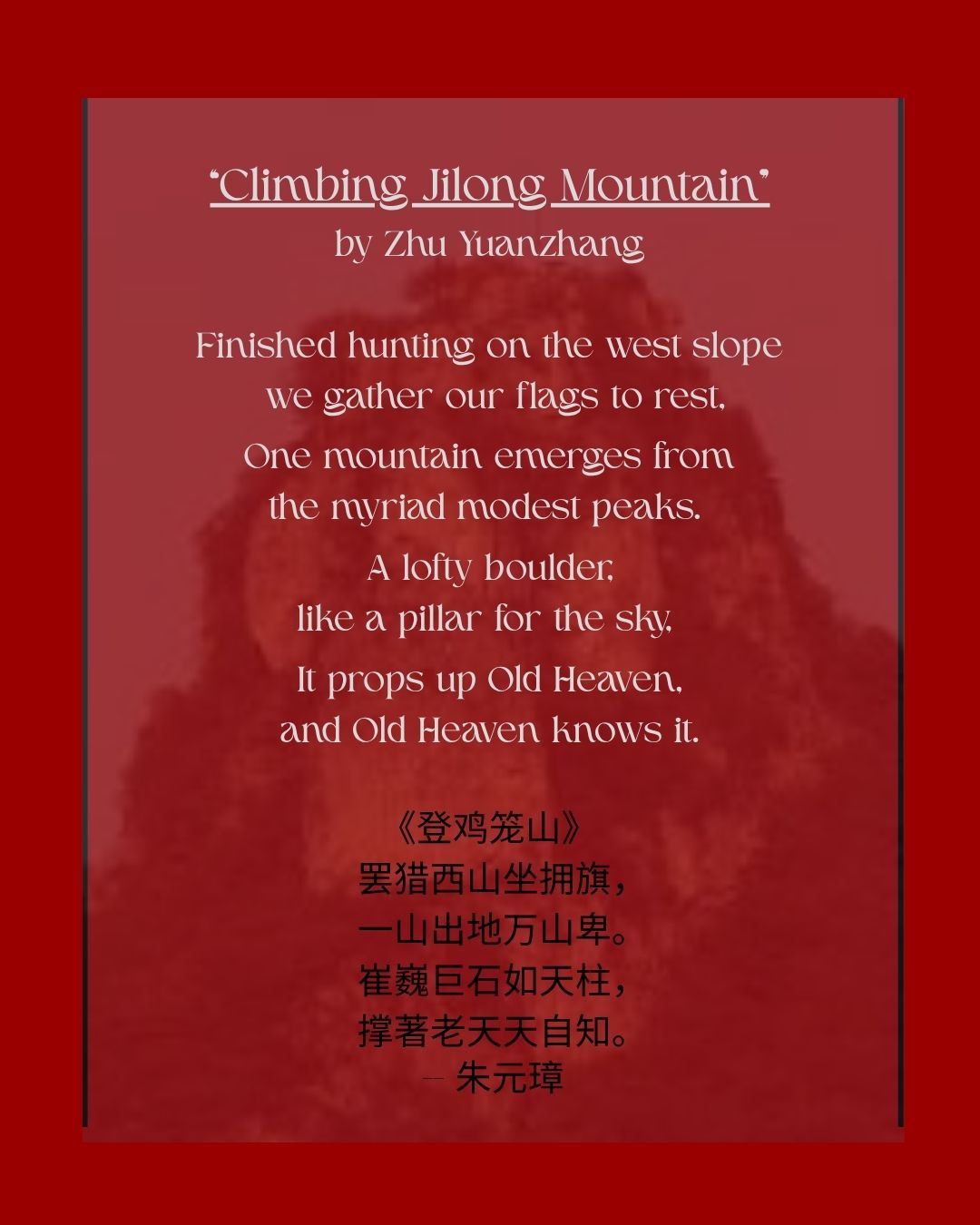
Poem in English and Chinese, "Climbing Jilong Mountain"

October 21, 2025, marks the 697th birthday of Zhu Yuanzhang, founder of China’s Ming Dynasty. He was born (on what corresponds to Oct. 21 on our modern calendar) in 1328, founded the Ming Dynasty in 1368, and died in 1398. Those lucky eights seem auspicious except that they are based on the Western Gregorian calendar and would have meant nothing to Zhu Yuanzhang himself. In the context of his era, he was born in an Earth Dragon year on the 18th day of the 9th month of the 1st year of the Tianli 天曆 reign of the Mongol Yuan Dynasty’s Wenzong 元文宗 Emperor Tugh Temur.

However you cite it, we are a mere three years from the big 700!

To mark this day, here’s a poem that is attributed to Zhu Yuanzhang. Written in 1355, it’s titled “Climbing Jilong Mountain” and describes the view of a summit near today’s Hexian, Anhui Province, located along the northern banks of the Yangtze River:

Continue reading

The anthem of the Red Turban Rebellion

It’s an incendiary lyric with no title by an anonymous author. I consider it the anthem of the Red Turban rebellion because it describes, in catchy rhyming phrases, the political and economic breakdown that toppled the Mongols in 14th-century China.

This was the same rebellion that Zhu Yuanzhang joined and eventually led, fighting his way from Anhui Province south across the Yangtze River to the city known today as Nanjing, where he established the dynasty that replaced the Mongol Yuan: the Great Ming.

According to the scholar Tao Zongyi 陶宗仪, who lived through this era, the song was soon on everyone’s lips.  He included the words in his vast collection of anecdotes, noting “I don’t know who created this lyric to the Zui Tai Ping tune, but from the capital to Jiangnan, everyone can recite it.” (《醉太平》小令一阕,不知谁所造。自京师以至江南,人人能道之。)

Continue reading

Crossing the river

Though I’m not into numerology, it did give me pause to realize that one of the key moments in the founding of the Ming Dynasty occurred exactly 666 years ago.

On the second day in the sixth month of an Yiwei year that corresponds to the Western date of July 10, 1355, Zhu Yuanzhang led his newly-acquired fleet from Hezhou, his temporary base on the northwest bank of the Yangzi River. He was headed toward a outcrop on the far shore known as Ox Barrier. One of Zhu’s newest recruits, Chang Yuchun, was the first to make landfall. Chang jumped to the shore, wielded his ax and rushed toward the Mongol troops. Zhu Yuanzhang’s Red Turbans surged behind Chang’s charge and routed the imperial army from their fort in the cliffs. Chang’s attack was so heroic that it is said you can still see his footprint in the boulders above the site of the landfall.

Such are the tall tales told of that fateful moment.

Continue reading

A herd boy story for an Ox Year

The Lunar New Year for 2021 starts Friday, Feb. 12. Up next in the cycle of the Chinese zodiac animals is the ox.

Since I have been writing fiction about the life story of Zhu Yuanzhang, founder of the Ming Dynasty, an ox year brought to mind stories of how the founder started out as a cattle herder.

Collections of stories about Zhu Yuanzhang’s childhood often include a subversive one from his herd boy days. It comes in a few different forms, but always has the future emperor leading his fellow herd boys in eating one of the animals they are supposed to be protecting.

Continue reading

My son, my book cover artist

Structuring a novel is a murky process, but one moment stands out in my mind as key to both my novel, The Lacquered Talisman, and its cover, which was created by my son.

I was sitting on the floor of a bookstore in Boston, flipping through art books about China, when suddenly it hit me: What I needed for my main character was a talisman. And this talisman would be a seal chop. The Lacquered Talisman is about the Zhu family, whose youngest son founded the Ming Dynasty in 1368. I needed a tangible item that could symbolize family for my protagonist. Thus the talisman. Continue reading

Re-opening for business…a ‘Call to Commerce’ Tower in 1100s China

The city leader was concerned that all the businesses in his town were shuttered. People were afraid to go out. He asked the central government for tax relief, and then embarked on a major project to get people shopping again.

Sound familiar? The concerns are the same type that officials today are dealing with in the face of COVID-19, but the city leader I am referring to is Xin Qiji 辛弃疾, one the Song Dynasty’s military prefects in Chuzhou 滁州, a city across the Yangtze River from Nanjing in China’s heartland. And the danger Xin Qiji faced in the 12th Century was not a pandemic, it was the Jin cavalry poised for yet another invasion from the north. Xin Qiji’s signature solution was also not something mayors or governors in the U.S. are currently considering: he built a soaring pavilion, the tallest structure in Chuzhou, located in today’s Anhui Province.

“Literary types love towers, this has been true since ancient times,” wrote Qian Niansun 钱念孙 in a recent travel book about Anhui. “Most climb or build them either to visit scenic spots or wax poetic, but Xin Qiji established Pillow Pavilion 奠枕楼 in Chuzhou for quite another reason…Pillow Pavilion was actually an 800-year-old ‘Call to Commerce Tower.’” Continue reading

The impact of the Black Death on 1300s China: No plague = no Ming

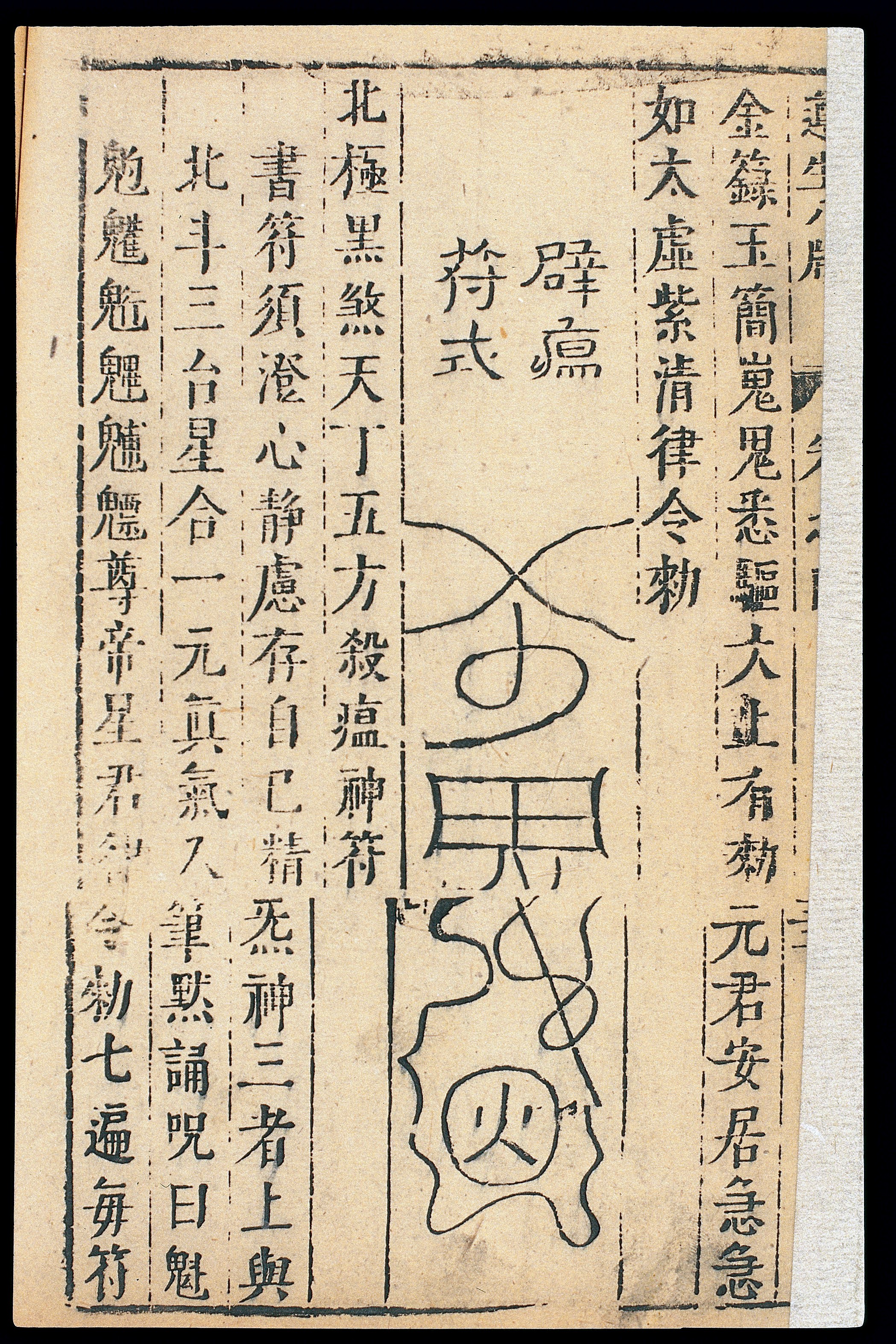
PlaguePreventionTalisman
19th-century woodcut with a talisman for warding off the plague. (4/19/2020 Twitter post by Medieval Asia researcher Jeffrey Kotyk)

If not for the plague, China wouldn’t have a Ming Dynasty.

This startling thought has been on my mind as I sit at home in quarantine, enduring the epidemic of my era: COVID19.

Of course, if the Ming had not been founded in 1368, some other dynasty would have followed Kublai Khan’s Mongol Yuan. Perhaps the salt smuggler Zhang Shicheng would have prevailed with his Great Zhou Dynasty based in the city of Hangzhou (which the Ming founder squashed in 1367). My point is that the plague is what propelled the Ming founder onto the path that led to the founding. It is the single incident that pushed him off his expected trajectory of farming alongside his brothers in the fields along the Huai River. Zhu Yuanzhang was the youngest of four sons. If not for the plague, he would never have left his large family, which needed him in the fields. He death would have been unremarkable and we would know nothing about him. Continue reading

The never ending story of translating Chinese texts

stele
The 14th-century stone tablet inscribed with the Ming founder’s life story.

It took the founder of China’s Ming Dynasty ten years to get his life story published – as a text carved into a stone tablet still standing in northern Anhui Province.

It took another 639 years to get that story translated into English – as a PDF on my blog.

The original text was finalized back in 1378 when the carving was complete and the tablet was placed on the back of a huge stone turtle.  The English final draft will probably never stop getting tweaked, most recently today, when I took the suggestion of a student at UC, San Diego and revised the concluding line. That’s the nature of translation: an imperfect but necessary process that can always be improved.

Continue reading

So my book about the plague is a victim of coronavirus…

According to my publisher, my first novel is now waiting in some printing queue in China, one small item lost in the general shutdown resulting from the coronavirus. Ironically, “The Lacquered Talisman” focuses on how the Zhu family dealt with the contagion of their era: the plague. When the day comes that I am able to hold a copy of my book in my own hands, I will feel a measure of relief that the current contagion is subsiding. Until then, my thoughts are with all those in China dealing with this crisis.

Here is how Zhu Yuanzhang wrote about the impact of contagion on his family: Continue reading